



The season hasn’t even started, and some are already sounding the alarm on Syracuse men’s basketball.
After a 20-point blowout loss to UConn in its preseason opener, the Orange barely escaped with an 81-76 win over Siena — a team that lost two of its top three scorers, Gavin Doty and Francis Felefac, along with its head coach to Syracuse after last season’s tournament campaign.
Over two exhibition matches, the Orange were outrebounded by a margin of 14, shot just 24% from three point territory, and were outscored in the paint by almost 30 points.
Not ideal, I know.
But the outcry from Orange Nation has been even more alarming.
Following SU’s narrow win over the Saints, declarations stating “it’s over”, “this program is dead” and “I have a really bad feeling” flooded social media.
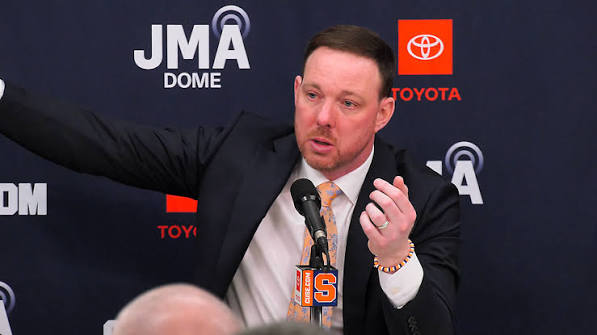
Some went as far as to write off Gerry McCnamara’s day one goal of bringing Syracuse back into national relevancy — a vision the former Orange star guard and 2003 national champion made clear during his introductory press conference earlier this year.
And while it’s reasonable to believe — like anything on social media — that the heavy social media blitz does not completely reflect the overall pulse of Orange nation, many do hold an unrealistic timeline of when change should come and what it should look like.
Dubbed the “Curt Cignetti curse,” Indiana football’s remarkable two-year turnaround — from one of the losingest programs in FBS history to an undefeated national championship run — has led many to treat that kind of overnight success as the expectation rather than the exception.
And even with the current “lawless”, NIL driven state of college athletics, where college athletes have taken the role of semi-pro athletes, immediate overhaul and results are still extremely hard to turn into a reality.
It takes time.
Syracuse returns just four players from last year — including guard Noah Lobdell who saw just 4 minutes of playing time. In this, losing each of its top three scorers, Donnie Freeman, Nate Kingz, and JJ Starling, rebounding giant Donnie Freeman, and floor general Nate George.
Kiyan Anthony and Sadiq White — two highly rated recruits from 2025 — are back for another season, but are far from finished products.
Anthony has especially struggled early in the campaign. The sophomore has just six points on a startling 2-for-14 shooting performance and played only eight minutes against Siena.
The Orange have added key pieces in Siena transfer Gavin Doty and former Appalachian State player Luke Wilson, who combined for 30 points in SU’s weekend victory. But even with those additions, there are still questions about the roster’s ability to compete at a higher level.
The biggest hurdle, however, isn’t simply developing a relatively experienced but overlooked group of players. It’s changing the culture.
Syracuse basketball is far from what it was when McNamara was tearing up the Dome, or even in the middle 2010s when he was a young assistant coach.
Syracuse basketball is far removed from what it was when McNamara was tearing up the Dome as a player, or even in the mid-2010s, when he was a young assistant coach.
The Orange haven’t made the NCAA Tournament since 2021, and the three seasons that followed Jim Boeheim’s retirement only deepened the program’s struggles. Under Adrian Autry, Syracuse indulged in back-to-back losing seasons, combining for a 13–25 conference record over those final two years.
But the problem wasn’t simply that Syracuse stopped winning. The Orange were routinely outhustled on the boards, beaten in transition and outmatched physically by conference opponents — a sentence hard to believe after a sweet-16 run just 4 years ago.
That is the culture McNamara has inherited — and the one he now has to change.
McNamara knows what Syracuse basketball can be. He was part of the program’s greatest moment, and now he has the opportunity to help restore that standard. But returning to the top won’t happen overnight, and two preseason exhibitions aren’t enough to determine whether he’s on the right path.
Orange Nation has every reason to want its program back. The question is whether it’s willing to give McNamara the time to build it.


